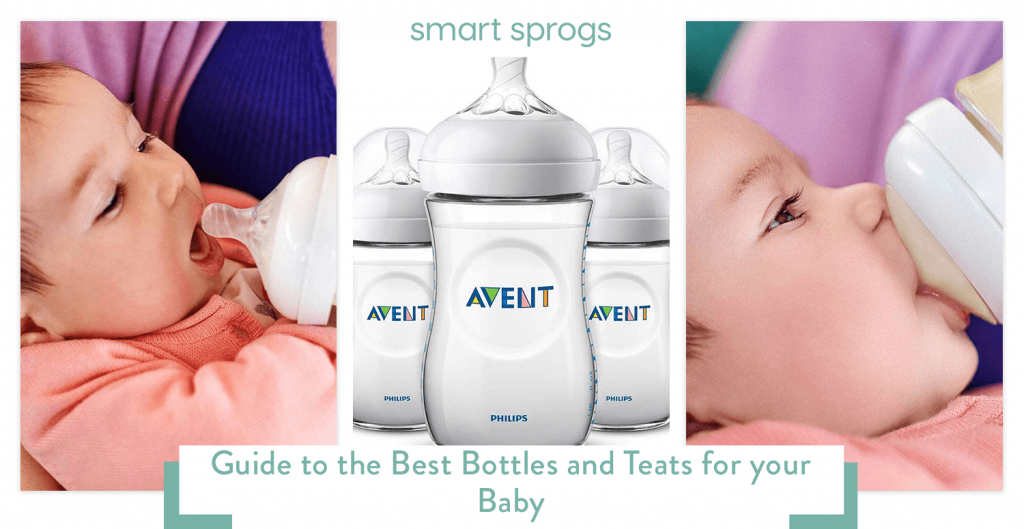
For a first-time parent, making the decision to use bottles to feed their baby can be empowering and a relief. It can also be overwhelming! There are so many options out there that choosing the right amount and type of kit is mind-boggling.
Never fear! As always, we’re here to help you! Our useful bottles for babies shopping guide will help you to decide which newborn teats to try and where to source the best baby bottles UK retailers sell. We will also answer the most common questions, from ‘How many bottles do you need for a newborn?’ to ‘How will I know when to change teat size?’.
The best teats and bottles for babies – a shopping guide
Types of babies’ bottles
Sizes of bottles
There are two main sizes of baby’s bottle and which one you use depends on the amount of milk your baby is drinking per feed.
- Newborn bottles will hold 150ml of breast or formula milk.
- A baby’s bottle for hungrier mouths will be 260ml in size.
Don’t be tempted to avoid buying newborn baby bottles of 150ml bottles because they won’t be used for long. They are the best newborn baby bottles as small amounts of milk will flow better out of them.
Anti-colic baby feeding bottles
The best anti-colic bottles have a dedicated preventative valve in the teat or body of the bottle. The key to minimising how much your baby suffers from painful colic is reducing how much air they swallow.
Bottles suitable for breastfed babies
Features of the best bottles for breastfed babies UK websites offer?
- Soft and smooth teats that are usually made from silicone.
- Ridges or petals at the base of the teat which will feel like a nipple.
- Wide neck teats that have a smooth curve. This will rest against your baby’s chin and mouth just as your boob would.
- Flow systems that will respond in the same way as a breast when baby sucks.
Self-sterilising bottles
Self-sterilisation is a feature that is quite new to the nursery market. So, how does it work? It’s super simple!
- Wash the bottle thoroughly.
- Put 20ml of water into the bottle.
- Pop it in the microwave for 3 minutes.
- Bing! The bottle is ready.
Easy grip bottles
As your baby grows, they will show more interest in feeding themselves. A bottle that has a hole in the middle and two handles is a fab way to encourage that independence.
These kinds of bottle are usually cheaper and will have fewer of the features such as anti-colic or teats shaped like a nipple.
How many baby bottles do you need?
How many baby bottles do I need? That is the ultimate question that a soon to be bottle feeding parent will ask. You will want enough for a day of feeds without needing to frantically wash and sterilise but not so many that you will waste money.
We recommend buying one bottle and teat of a particular type to test how your baby will respond. When my first child was tiny, she flatly refused to accept the first five kinds of bottle we introduced her to. There is no such thing as a bottle babies all love!
Once you have found a bottle and teat that your pride and joy will happily feed from, then follow these guidelines as to what to buy initially:
- At least six small baby bottles of 150ml capacity.
- At least six standard baby bottles of 260ml capacity.
- At least six slow flow baby bottle teats and four medium flow in case you have a hungry baby.
- A bottle cleaning brush.
- A steriliser to keep bottles safe and hygienic at each feed.
Types of bottle teats
Baby bottle teat sizes
Each size of teat will have a different number of holes in the tip to adjust the amount and speed of milk as it flows.
- Slow flow baby teats – 0+ months
- Medium flow teats for babies – 3+months
- Fast flow bottle teat – 6+ months
- Vari-flow teats that change their flow according to the strength of suck
Anti-colic
Teats for bottles that advertise themselves as ‘anti-colic’ will minimise any excessive mixing of air with the milk. Bubbles cause wind and that will leave your tiny tot with tummy ache and an upsetting need to burp!
A teat with a nipple shape and texture
For many babies, this style of teat increases acceptance and helps them to latch on just as they would during a breast feed.
- A bottle teat constructed from smooth and silky silicone.
- ‘Wrinkles’ at the bottom of the teat.
- A curve that will feel the same in baby’s mouth as Mum when they latch.
- A wide neck that will feel the same against a newborn’s lip and chin.
- Material that has the same flexibility as feeding from Mum.
‘Traditional’ teat shape – deliberately unlike a nipple
Some babies will struggle to accept the change from breast to the bottle. There are lots of bottles with teats that mimic the feel of a nipple but sometimes trying a teat that is totally different can be the key to success! If you’ve tried each and every bottle and your little darling still refuses, take one last shot and you might be surprised.
Material
- Silicone is durable but can be inflexible. Some companies such as Avent has developed a silicone that feels and acts the same as a woman’s nipple.
- Latex is usually soft and malleable. It’s a delicate material which is kind to a baby’s mouth. Latex teats will need to be replaced more often, especially when tiny teeth begin to develop.
- BPA free – BPA is the short form for a chemical that used to be present in lots of plastic products like baby bottles and toddler cups. It has been proven to be detrimental to the health of humans, especially infants and foetuses.
Signs that your baby need faster flow teat options
It’s easy to see when your baby is drinking from a teat that is too fast. They will splutter as the excess milk dribbles down their cute little chins. Wind and colic will also become a problem as they gulp more air.
So, when to change teats? A baby who needs a stronger flow of milk will grow frustrated during a feed.
Just because they are getting older doesn’t mean a baby needs to move up the bottle teat sizes. As with most aspects of parenting, take your cues from your son or daughter, they will tell you when to use size 2 teats on their bottles of morning milk.
Leave a Reply