Whether we, as parents like it or not (or have the strength for it or not) – everything that touches the baby, especially in the first few months must be as clean as possible. When it comes to most of the equipment you will be using, like baby bottles, you will find that it to be sterilized (freed from bacteria) before each use. Not so long ago, our parents and their parents had to resort to boiling water for that purpose. Thankfully, in this day and age, we can just buy a baby bottle steriliser.
Bottle Sterilizers
Sure, you can go through the whole process of breastfeeding and formula feeding without investing in any additional gadgets. What I found, however, is that whatever I ended up buying or even borrowing, just ‘’to try out’’, I soon could not live without. It made my life so much easier to own a baby bottle sterilizer, which is why I have created a list of my recommendations for you, in case you are dwelling about purchasing one.
Baby Sterilisers Are Not Magic Wands
I’m sorry if my recommendation didn’t offer a magic trick solution to sterilising baby bottles – sure, the process still takes some time and it’s not like they are coming out with self-sterilising bottles anytime soon, but these gadgets do help a lot! How do you sterilise your bottles? Do any of you boil the bottles in the water? And if so, why? Let me know in the comments!
As glorious and empowering as motherhood is, having a baby takes a huge toll on a woman’s body. Your incredibly clever and magical self has grown a baby, birthed them and is now feeding it. You are truly amazing!
Rest, recovery and getting a bamboozled brain around the massive life change should be the priorities over ‘getting back in shape’. However, exercise is a wonderful balm for the soul and mind and a trip to the gym or run may help you feel more like yourself.
Finding a nursing sports bra that fits well, is supportive and feels comfy is the first step to successfully combining breastfeeding and training.
A maternity sports bra in your new, no doubt bigger, cup size could work. However, consider a specific breastfeeding sports bra so that it’s easy to pop your babe on the boob as soon as you get home or pick them up from the gym creche.
The best nursing bra for sport – a shopping guide
It’s a great idea to shop for a bra based on the sports that you’re planning to do. The best maternity bra for CrossFit or running will differ to the best maternity bras for Yoga and Pilates.
Make sure you use measuring and ‘what’s a good fit?’ guides to make sure you buy the sports nursing bra that is perfect for you.
It’s best to measure for and buy your sports bra once breast feeding has been established. Your breast size and shape may change a lot in the first few weeks after birth.
She fit bra is one of the leaders in maternity sports bra, unfortunately it’s almost out of stock across the UK. It’s almost impossible to find one due to a ‘supply and demand’ issue. So we’ve selected here the best alternatives to the Shefit bras available in the UK.
What is a breastfeeding bra and what features to look for?
Hopefully you’ve managed to find some comfy, pretty and supportive nursing bras that have seen you faithfully through your pregnancy. The best nursing bras are designed with ease, access and support as a focus.
The best breast-feeding bras will have the following features:
A clasp on each side to drop the cup so baby can feed without restriction.
Wide supportive straps.
Straps to hold the bra secure while the cup is dropped.
Adjustability in the shoulder straps and back strap to allow for changes in breast size during the breast-feeding journey and as milk supply ebbs and flows.
Soft fabric with some stretch. Preferably a quick drying, moisture wicking cotton in case of leaking.
No wires at all or flexi-wires that won’t dig in.
A pocket or padding in which to tuck a breast pad.
What size of nursing bra should I buy?
Once your tiny bundle of love has arrived and breastfeeding has begun most new Mums will find they have much bigger boobs. An increase of two cups sizes is common.
It’s important to get fitted properly for a supportive nursing bra by a specialist in shops such as John Lewis, Debenhams or Marks & Spencer.
There are complex factors to consider including both the increase in boob size and shape and the decrease in band size as you lose pregnancy weight.
For a guide to at home measuring and how a correctly fitting bra should look and feel follow this link.
How is a breast-feeding sports bra different?
Running while breastfeeding is perfectly fine if you’ve fully recovered from the birth and you’re wearing a super supportive maternity bra or nursing bra.
Buying a specific bra for sports while nursing will make sure your boobs stay bounce and pain free and here’s why:
Extra wide straps with lots of hooks and eyes.
A design to prevent bounce.
Padded shoulder straps.
Fabric designed to be supportive, moisture wicking and quick drying.
Full coverage of the breast.
A clasp on each side with which to drop the cup for unrestricted feeding.
As a new Mum we have so many things to think about, let alone breast pads and leaking boobs! Worst nightmare right? It does not have to be. Do not worry Mummy, we have you covered.
One of the most commonly asked questions expectant mothers ask about breastfeeding is whether they will need maternity breast pads. In this article, I will guide you through my recommendations of the best nursing pads I found.
Best Breast Pads to avoid the leaks
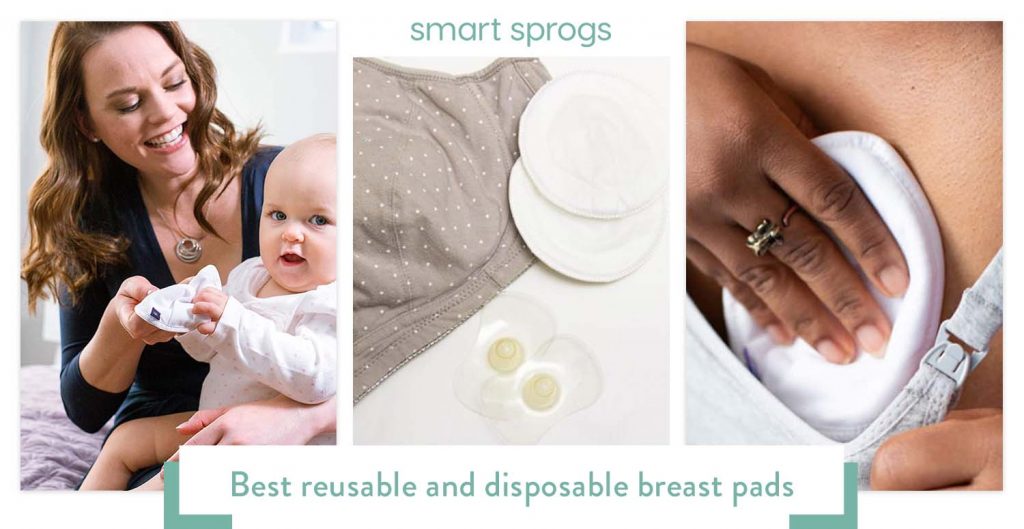
You would think that a breast pad is a fairly easy product to choose but did you know there are so many different types? Five in fact. It is a matter of personal preference which one you opt for. You may have to experiment with a few in the beginning. Let us keep things simple for now. The first being:
The best reusable nursing pads
Best disposable nursing pads
Homemade breast pads
If you are feeling creative you can make your own homemade breast pads.
Admittedly this would be very time consuming but you could make them ready for baby’s arrival.
You can also tailor them to your taste and needs. You can choose which type of material to use whether that be bamboo or cotton. You can even have a fancy pattern or keep things plain.
Pros:
Choose your own material
Unique
Cost effective
Eco friendly
Easy to follow instructions on how to make
Con:
Time consuming
A step by step guide on how to make homemade breast pads can be found here.
Do you need nursing pads?
What is a breast pad?
A breast pad is a removable liner which is placed inside a bra to absorb leaking breast milk. It can also help prevent staining your clothes. Breast pads need to be changed frequently to prevent infections from developing.
Do you need it? It’s indispensable for me. As an active mum I don’t want to always be peeking at my boobs to make tsure they haven’t leaked.
Accident will happen, you won’t be able to control it or sometimes even feel it and the last thing you want is to end up with a stain on your shirt.
Nursing pads will be your best friends to avoid awkward milk accidents.
Help with breastfeeding
So you have established that you want to breastfeed but somehow it is not quite as simple as that. There is all the paraphernalia that accompanies it like nursing bras, breast feeding pillows, expressing machines and nursing pads! Where do you start?
I remember when I was pregnant with my son I had an overwhelming desire to breastfeed him. Mother’s instinct I guess. We only had a short breastfeeding journey but I cherish the short few months in which I was able to. I also feel like I learnt a lot and would be fully prepared if baby number two came along in the future.
There are so many resources available to help prepare you for your breastfeeding journey. Research your local antenatal classes. Here you will learn positioning techniques, attachment as well as common problems faced and how to overcome them. You will also meet other Mums who will be of great support to you.
Other sources of help include your GP, midwife and health visitor. Never be afraid to reach out to someone whether that be a friend or a family member. Discuss your desires, fears and or concerns.
Each woman’s journey is very different and unique. There will be a lot of learning and experimentation until you feel settled and comfortable in a routine that suits you and your baby.
Breastfeeding is a skill and a skill has to be learned. It will take time, hard work and perseverance but the rewards will far outweigh any difficulty.
Wrapping up
As you can see, the world of breast pads can not only be daunting but confusing too! How do you know which one is best? With a little bit of research and experimentation you will find the one that best suits your needs. Will you be the Mum who will lovingly stitch her own handmade breast pads or will you be ditching the creativity for convenience and opting for the disposables? Either way, whatever breast pad you choose you can rest assured that you will not be that Mum wondering why people are staring at her breasts.
Let us take one thing off your mind, breast pads.Did you know there are 5 different types of breast pads on the market?. Find out which option best suits your breastfeeding journey.
A premature baby or they are not able to suck, you want to go back to work or simply need to take a break … a breast pump can be a valuable ally for any mother who wants to continue breastfeeding their baby.
Follow these tips to achieve and maintain optimal milk production.
From day one. I’m not going to lie the first three / four days after birth are complicated, the extraction of colostrum with a breast pump is not done well. It is necessary to wait for the rise of milk.
The breast pump can then be useful for babies born before term or low weights that do not always have the energy to suck. With a breast pump, you’ll be able to stimulate lactation so that your baby makes less effort to suck the milk out, and reduce the duration of their breastfeeding sessions, at least the first two weeks.
Which breast pump to choose?
Electric pumps, manual pumps, double pumps…There are many models of breast pumps, each with their own strengths and weaknesses.
Electric breast pumps are the most used as they are the most efficient in terms of lactation. The latest generation of breast pumps even offer a double or simple pumping, they are at once small, silent and painless.
As for manual breast pumps, they can be a little tedious, because you have to pump the milk by hand, but they have the merit of being quiet, light and compact.
In any case, the most important thing is to find the pump that best suits your needs, your living environment, your milk production, the needs of your infant and your budget. Our guide on the best breast pumps should allow you to choose the one that suits you best.
Could my baby end up preferring the bottle to my boob?
It can be a thought that scares you if you intend to keep breastfeeding directly from the source.
Long story short, it’s highly unlikely.
On the contrary when your baby grows they might start refusing the bottle. They won’t want to take the bottle and not the boob, while he is in contact with your breasts still full of milk.
If it’s the case and you want to give him a bottle, it is then preferable that the bottle is given by someone else than yourself, even more efficient if it’s a third person external to your household.
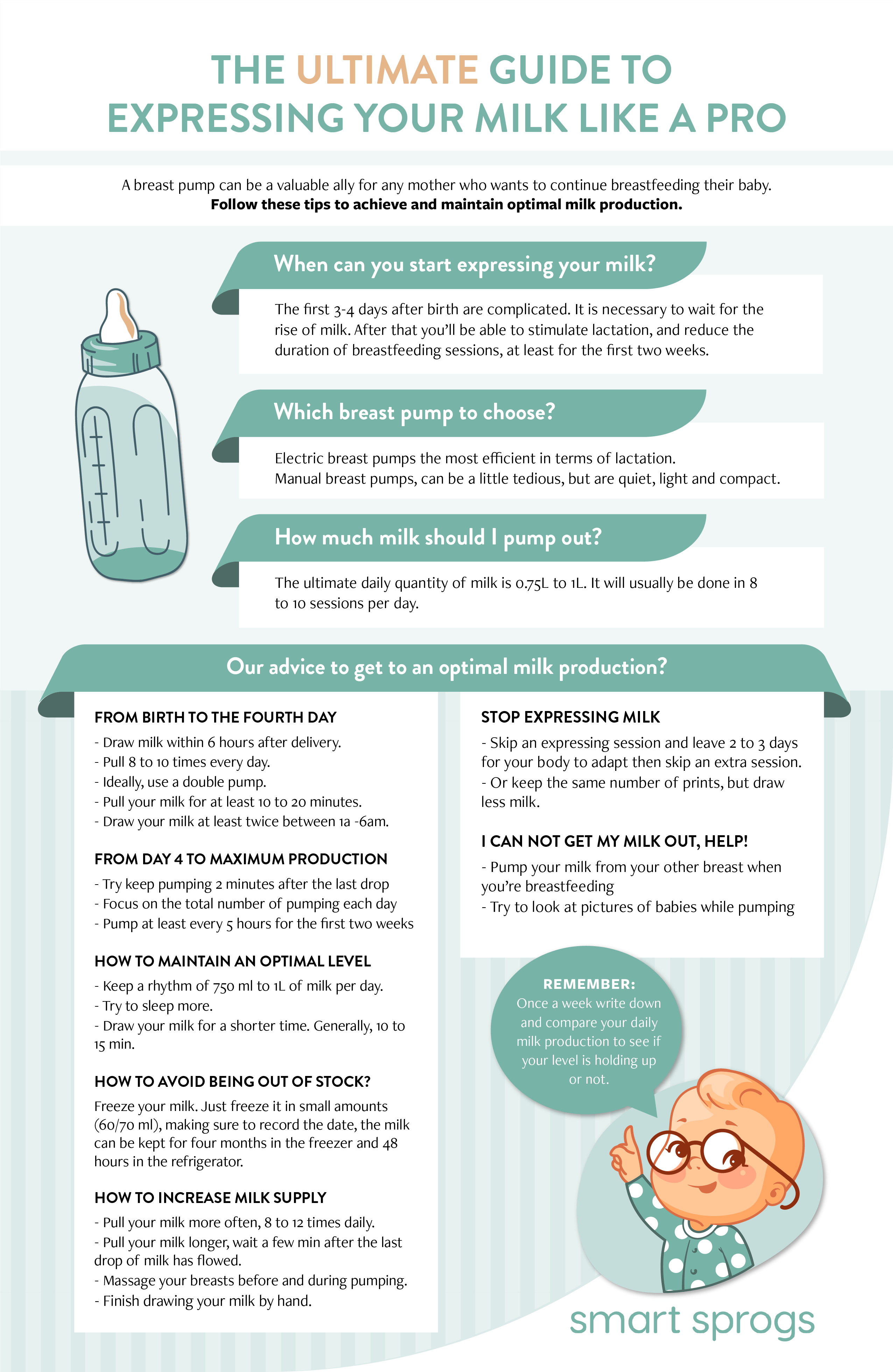
Our advice to get to an optimal milk production?
Drawing milk frequently sends a strong signal to the body so that it produces more milk … The more often you empty your breasts, the more milk they will produce.
From birth to the fourth day
If you can, draw milk within 6 hours after delivery. Use a hospital breast pump at the beginning to produce a lot of milk. You’ll produce a little colostrum at the beginning
As soon as possible, pull 8 to 10 times every day. This is the number of times your baby would be breastfeeding each day. In any case, the more you shoot each day, the more milk you will produce. The opposite is also true, the less you shoot and the less milk you produce.
If you can, use a double pump. It will save you time and boost production faster.
Pull your milk for at least 10 to 20 minutes then finish by massaging your breasts by hand. Use the cushion to harvest the milk that will come out thanks to the manual massage.
To increase milk production, try to draw your milk at least twice between 1am and 6am. In the early hours of the morning, the level of hormones that produce milk increases!
From day 4 to maximum production
At the end of the 4th day, you should almost reach an optimal level by making the following changes:
Draw your milk longer, try keep pumping 2 minutes after the last drop of milk or until your breasts feel completely empty.
Focus on the total number of pumping each day (8 to 10 times every 24 hours) rather than the time between each draw (every 2 to 3 hours). However you should not let more than 5 hours go by without drawing your milk for the first two weeks of your baby’s life.
Maintain an optimal level
When you reach the 750 ml to 1L daily level, you’ve reached your goal! Most mums can now draw less times while maintaining this volume of production.
My advice for this phase:
Keep a rhythm that gives 750 ml to 1L of milk per day
To maintain your maximum production level, you must try to sleep more. The majority of mothers draw milk before going to bed and then in the morning when they wake up … Try to do the same and analyze if it does not cause clogging or if it does not diminish your milk production
Draw your milk for a shorter time. Generally, 10 to 15 minutes are enough.
Once a week, total the milk you have shot in the last 24 hours. Write it down and compare weekly to see if your level is holding up or not.
How to avoid being out of stock?
Nothing will ever replace your baby sucking, it’s always more effective than a breast pump. To fill a bottle of 200 ml, it is necessary to pump at least two or three times.
So it becomes a question of organization. If you’re going to rely more heavily on bootle feeding, you should start to freeze your milk. Just freeze it in small amounts (60/70 ml), making sure to record the date, the milk can be kept for four months in the freezer and 48 hours in the refrigerator.
If you do it regularly, you’re sure to always have some milk available for the days you can’t breastfeed.
Increase milk supply
If you need to increase milk production, the faster you work, the sooner you will have results. Here are some things to try:
Pull your milk more often, 8 to 12 times every 24 hours
Pull your milk longer, wait a few minutes after the last drop of milk has flowed
Make sure the cushion for your nipple still fits, the size may change over time
Massage your breasts before and during pumping
Finish drawing your milk by hand
Stop expressing milk
When you have decided to quit drawing milk, it is important to remember to go step by step. Follow these tips for a safe stop:
Skip an expressing session and leave 2 to 3 days for your body to adapt and skip an extra session. In the end, you should only keep the first and last pumping of the day before stopping completely.
Keep the same number of prints, but draw less milk. For example, if each draw gave you 120 mL of milk, stop now at 90 mL. Allow two or three days for your body to adjust and then lower again. After a while, you will not feel the need to draw your milk.
Remember that in the “weaning” phase, if your breasts are too full, just pull what you need to make you feel good again. Leaving your breasts too full can expose you to pain and infection.
I can not get my milk, who can help me?
Don’t get too hard on yourself. There’s got to be a solution.
Try to pump your other breast while breastfeeding. If you need to express your milk without breastfeeding, try looking at baby pictures while doing it.
If none of it works, ask your GP for advice. You can also find a lactation consultant here.
Finally there are also some women that sell their milk online. It’s kind of a last resort solution but it could solve your problem.
If you need to talk we’re here. Message us, comment here and we’ll try to help you and share our experience as best as we can.
Pregnancy, birth and the early post-natal phase are pretty much all about feeling uncomfortable, sore and full of aches. Of course, your precious bundle makes it all worth it but wouldn’t it be nice just to feel a little less niggled by multiple parts of your own body. That’s why you need a breast pump that doesn’t drive you insane.
Every breastfeeding mother has her own lifestyle and a unique attitude towards breastfeeding. Choosing the best breast pump for you will depend on how you want to breastfeed your baby and how often you plan to feed it with a bottle.
Do you need to relieve breasts that are heavy and sore from too much milk?
Do you want your partner, children or parents to help feed your newborn?
Is there a need to boost your milk supply or store some milk?
Is your baby enable to not suck or eat directly from your breast?
Do you want to give breast milk to your child, but you do not want to breastfeed?
Are you the parent of twins?
If you answered yes to at least one of these question then you should consider a breast pump. You can’t be expected to breastfeed permanently and be with your baby 24 hours a day. If you want to continue giving your baby breast milk, a breast pump is a very effective way to maintain good milk production.
Having the right kit, such as a breast pump, oodles of breast pads, gallons of nipple cream and a nifty drop-cup bra to hand will make the first weeks much easier.
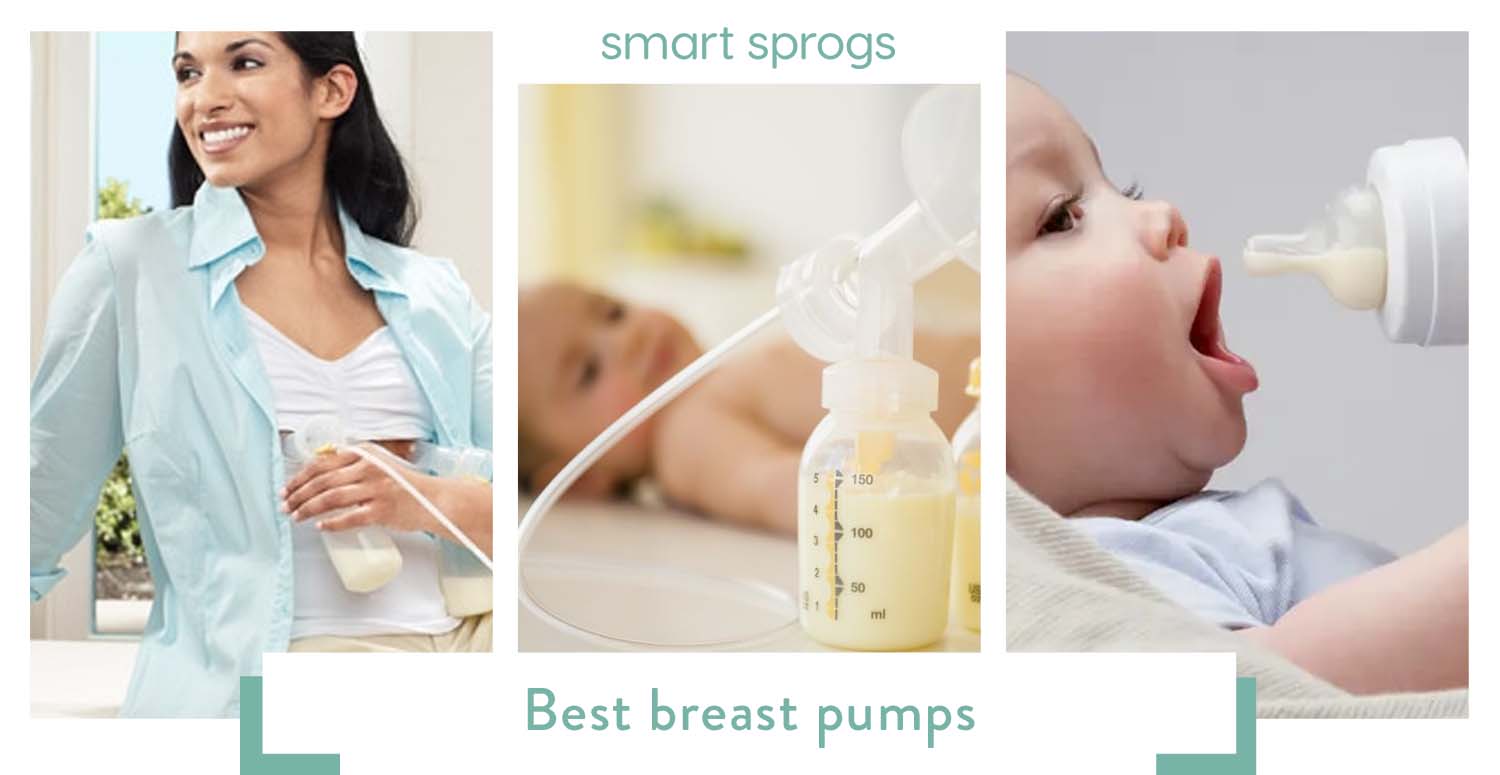
What is the best breast pump?
You could read breast pump reviews all day, every day and still feel confused about the right choice for you. It’s such a personal product as all bodies, boobs, women and babies are different.
I’ve selected the best breast pumps and tried to gather as much info as possible to help you choose the one that will fit you the best.
Manual breast pumps
The Pros
Cheaper. A good choice if you know it’s only for occasional use.
Light, compact and quiet. Ideal if you’re out and about a lot with another child or going back to work. The Haakaa breast pump is one piece, super lightweight and will fit in a handbag.
Easier to use than electric on full breasts.
The Cons
Pumping can tire hands and wrists so choose one with an ergonomic handle like the Mam manual breast pump.
You need hands to pump and hands to stop a toddler licking the cat.
Slower to produce milk.
May take time to learn the best rhythm to pump. A pump with ‘two phases’ one for initial pumping, the other for established milk flow.
Electric Breast Pumps
The Pros
Less effort. The cup is placed on the breast by you and then the machine takes over. No hand tiring pumping or fiddling with the suction controls.
Faster more productive expression. Electric breast pump reviews will consistently tell you how much quicker they are. Parents with more than one child will find this invaluable. Yay! Extra Peppa Pig time with the three-year-old.
More settings and adjustability to suit all boobs, any soreness and different levels of milk supply.
Choice. Spend more and enjoy extra clever features.
The Cons
Significantly more expensive, even for the basic models.
Noisier and less discreet. May disturb a baby feeding on the other breast.
Cleaning and sterilising are more of a faff with extra bits and pieces to drop or lose.
Usually bigger and heavier than manual pumps.
What about a double electric breast pump?
Many designs of electric breast pumps will offer a double pump version. The benefits of expressing from both boobs at the same time far outweigh the slight indignity and your new found sympathy with dairy cows.
More effective, faster milk production.
The milk produced has higher energy content when a double pump is used.
Thorough drainage of the breast which leads to an increase in supply and higher quality milk.
Tips to draw your milk
Breast feeding is an emotive subject for many new parents. If you’re planning on trying to breast feed your new baby you’ll need support, patience and time.
If you are breastfeeding mainly:
Draw your milk in the morning. This is the time of day when you have the most milk.
Draw your milk between each breastfeed, either 30 to 60 minutes after or at least one hour before. This will leave enough milk for the baby to feed.
If you’re exclusively using a breast pump to feed your baby:
Try to draw your milk 8 to 10 times a day, every 3 hours or so. Normal production of breast milk is 750ml to 1L every 24 hours.
Once you have reached maximum milk production, try to maintain a pace that allows you to reach that 1L every day.
Every mum and every baby is different. So you have to what’s best for both of you. If you want more tips we’ve written the ultimate guide to expressing your milk with all our tips and advice to do it like a pro.
Feeding your baby is a mother’s most natural and strongest instinct. It’s about choosing what makes YOU and YOUR baby happy and healthy. Breast, bottle, mixed feeding, electric breast pump, manual breast pump or hand expression are all perfectly wonderful ways to nourish your child.